ISSN
Online: 2706-9443
Publisher
Sebha University, Libya

Open access · CC BY-NC-SA 4.0 · No fees
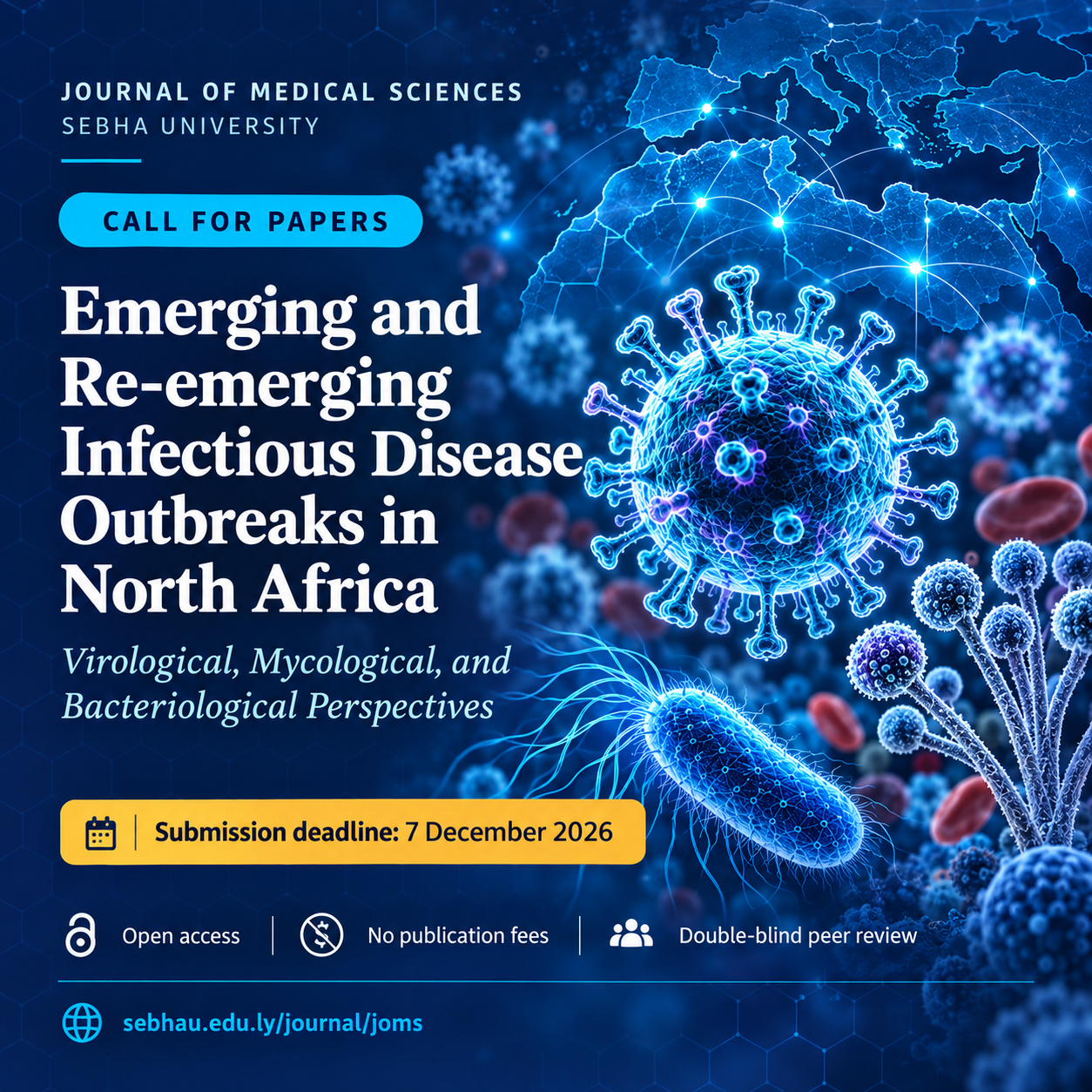
Special Issue of the Journal of Medical Sciences (JOMS), Volume 21, Issue 3 (2026)
| Submission deadline | 25 December 2026 |
| Submissions open | 1 October 2026 |
| Final decisions | Within 21 days of submission, and by 15 January 2027 at the latest |
| Special issue completed | 31 December 2026 (articles are published online continuously as soon as they are accepted) |
| Peer review | Fast-track double-blind review: final decision within 21 days of submission |
| Publication fees | None: no submission, processing or publication charges |
| Licence | Open access under CC BY-NC-SA 4.0; authors retain copyright |
Early submission is encouraged. Manuscripts submitted by 10 December 2026 are expected to receive a final decision by 31 December 2026 and to appear in Volume 21, Issue 3 (2026). Manuscripts accepted after 28 December 2026 will be published in Volume 22, Issue 1 (2027) under this special issue's section heading. Every accepted article is published online with a Crossref DOI within 3 days of acceptance.
Submit to this Special Issue ➜
Fast-track review · Decision within 21 days · No fees
Infectious disease outbreaks are occurring more often, spreading further, and causing more deaths than they did a decade ago. The Ebola disease outbreak caused by Bundibugyo virus in the Democratic Republic of the Congo and Uganda was declared a Public Health Emergency of International Concern by the World Health Organization on 17 May 2026. It is the latest reminder that a single zoonotic spillover can outrun containment within weeks. Hantavirus tells a quieter but related story: infections are appearing more often outside the regions where they were once considered rare, driven by shifting rodent ecology, land use and climate. Neither trend has stayed confined to where it began.
North Africa sits at the crossroads of these pressures. The region is in climatic transition, sees substantial cross-border population movement, and has public health systems that are still building their surveillance capacity. It is therefore a plausible site for the next unexpected outbreak. Yet outbreak data from the region remain thin in the international literature compared with sub-Saharan Africa, Asia or Europe. This special issue is intended to close that gap by providing a dedicated venue for rigorous, region-specific research on the viral, fungal and bacterial threats emerging across North African countries.
The special issue will publish work on emerging and re-emerging infectious disease outbreaks, whether viral, fungal or bacterial, that has a demonstrated epidemiological or clinical link to North Africa. We welcome studies that:
Topics include, but are not limited to:
The special issue accepts the following article types:
The special issue will open with an Editorial by the Guest Editors. Each article type follows the requirements in the journal's Author Guidelines.
Guest Editors
| Prof. Israa M. S. Al-Kadmy Mustansiriyah University, Baghdad, Iraq Google Scholar |
| Prof. Dr. Manal Hadi Ghaffoori Kanaan Department of Food Industry Technologies, Technical Institute of Suwaria, Middle Technical University, Baghdad, Iraq Google Scholar |
| Prof. Khaled Ibrahim Department of Microbiology, Libyan Biotechnology Research Center, Libya PubMed |
| Dr. Fatimah Alqdeeri Assistant Professor, Department of Microbiology, Faculty of Medicine, Sabratha University, Libya Google Scholar |
| Dr. Nadia Sifennasr Assistant Professor, Department of Microbiology, Faculty of Medicine, University of Tripoli, Libya Google Scholar |
| Dr. Fawzia Shawesh Department of Medical Laboratory, Faculty of Medical Technology, University of Zawia, Libya Google Scholar |
| Dr. Abdelhakam Hassan Ibrahim Ali Associate Professor of Molecular Microbiology; Dean, Faculty of Medical Laboratory Sciences, University of Al-Butana, Sudan Google Scholar |
Handling Editor
| Dr. Elloulu Ben-Darif Department of Microbiology, University of Tripoli, Libya Google Scholar |
Managing Editor (Special Issue)
| Dr. Shamsi Saad Shamsi Lecturer, Department of Research and Consultancy, Faculty of Medical Technology, Sebha University, Libya ORCID · Google Scholar |
Special-issue manuscripts go through the same double-blind peer review and meet the same standards as regular submissions. Final decisions rest with the journal's Editor-in-Chief. Manuscripts authored by any member of the special-issue editorial team are handled independently by another editor, and that team member has no access to their review. The process follows the journal's Peer Review Policy and COPE guidance on guest-edited collections.
To meet the special-issue schedule, manuscripts follow shortened target times: desk screening within 2 days, peer review within 10 days, an editorial decision within 1 day, author revision within 7 days, and final approval within 1 day. The review remains double-blind, with at least two independent reviewers, and the standards for acceptance are the same as for regular submissions. The speed comes from reviewers committed in advance by the Guest Editors, not from a lighter review. Authors must return revisions within 7 days to stay on the fast track.
Authors retain copyright of their articles and grant JOMS the non-exclusive right of first publication. All articles in this special issue are published open access under the Creative Commons Attribution-NonCommercial-ShareAlike 4.0 International License (CC BY-NC-SA 4.0). See the journal's Copyright and Licensing Policy.
For enquiries about this special issue, contact Dr. Shamsi Saad Shamsi, Managing Editor (Special Issue), at [email protected].
Submit to this Special Issue ➜
Fast-track review · Decision within 21 days · No fees




Fully open access under CC BY-NC-SA 4.0
Indexed in












Archived in

Author identifiers

JOMS requires an ORCID iD for corresponding authors.

All submissions are screened for similarity using Turnitin before peer review.


Journal of Medical Sciences (JOMS) · Published by Sebha University, P.O. Box 18758, Sebha, Libya · Online ISSN 2706-9443 · Print ISSN 2708-8553
 All articles are published open access under the Creative Commons Attribution-NonCommercial-ShareAlike 4.0 International (CC BY-NC-SA 4.0) licence. Authors retain the copyright of their articles. See Copyright and Licensing.
The design, logos and page text of this website are © Sebha University.
